PholarWeld Automation Equipment Co., Ltd.

Plasma (PAW)

Home > Welding Technology > Plasma (PAW)

Home > Welding Technology > Plasma (PAW)

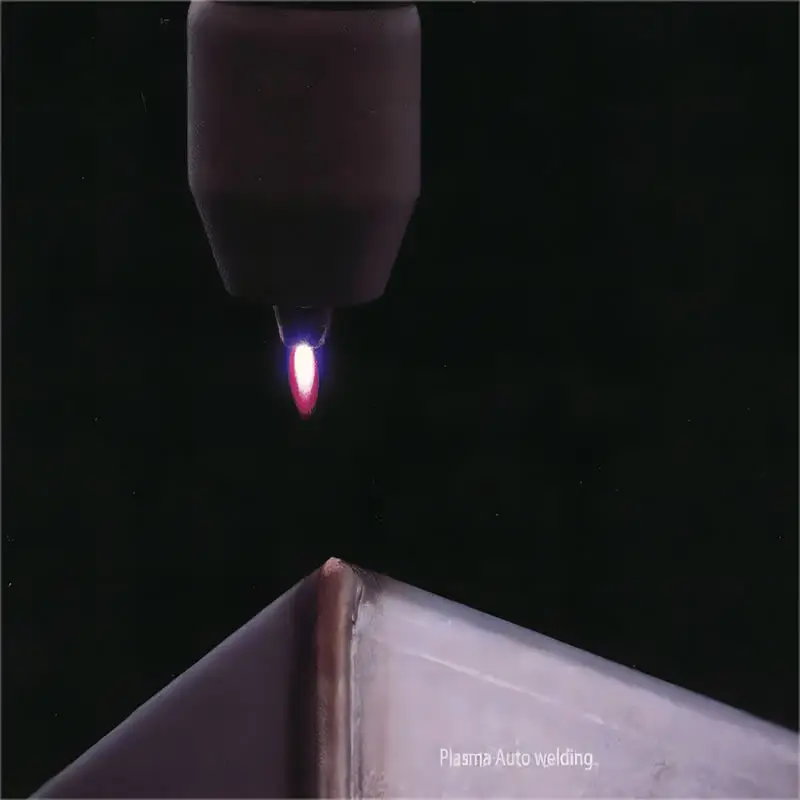
Plasma Auto welding PholarWeld
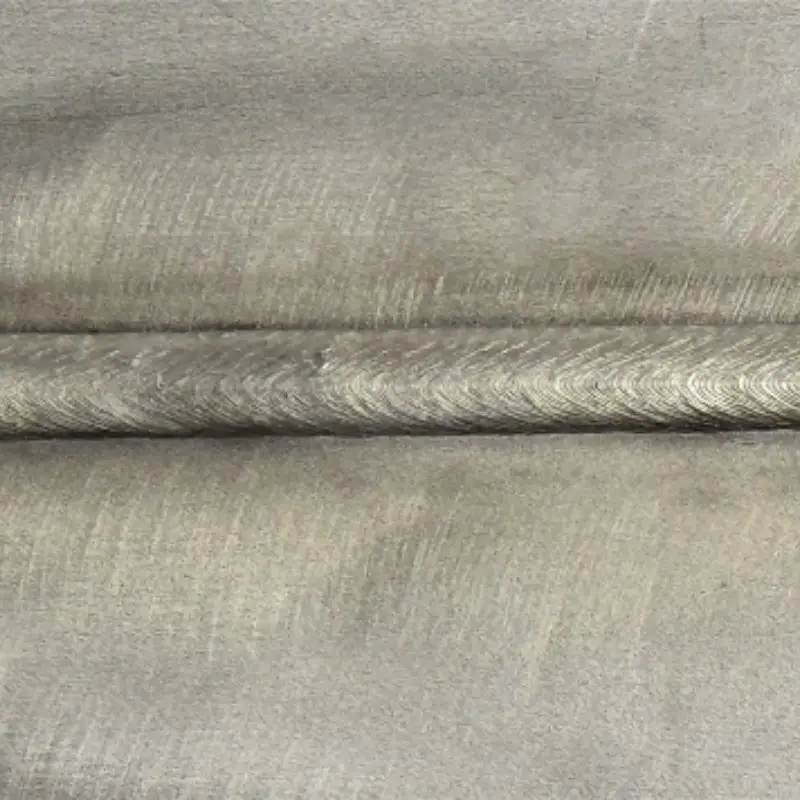
PAW Front weld
Plasma Auto welding PholarWeld
PAW Front weld

Paw Welding Technology Plasma Process Introduction


Plasma welding is using plasma arc as heat source, is an automatic welding technology, it has a great improvement in welding performance compared with the traditional TIG. Plasma gas is generally pure argon, which has good ionization and arc stabilization, the shield gas can be selected according to different materials.

Plasma arc is high temperature ionized gas which is generated by ionization, going through the special compression structure of the welding torch and spray from the central hole of the water-cooling torch nozzle to form a stable plasma compression arc, and melt the workpiece to obtain greater penetration. It is usually divided into transfer arc and non-transfer arc and mixed arc three types, commonly used technology is transfer arc technology.

Inquiry Now PDF Download

Introduction

Flexible Leasing & Sales

Breaking away from the single sales model, we offer diversified solutions combining "equipment sales + flexible leasing".

Non-standard customization

We provide professional non-standard equipment customization services to address customers' specific workpiece materials and complex process pain points.

Special Builds

If you have unique requirements, we offer special design options tailored to your specific requests.

Specification

Thickness(mm)Plasma +TIG welding speed(mm/min)Lon gas flow(L/min)Plasma weldingamp(A)TIG weldingamp(A)Single torch plasmawelding speed(mm/min)
3300~5002.5~4150~170200-220250-450
4280~5002.5~4165~195220-250260-400
5280~4603.5~4.5180-210230-260200-400
6250~4004.0-5.5190-220240-275180-330
8200-2504.5~6210-240280-330140-200
10180-2205-7220-260290~340160-220
12160~1806~8240-280300~350180-250
Plasma welding vs. manual welding
TechnologyPlasma Welding (PAW)Manual Welding(SMAW)
Operation MethodAutomatic or manual (manual plasma welding requires a special welding torch)Fully manual, flexible
Welding Position,All positions (but flat welding is best; vertical/overhead welding requires a full penetration weld)All positions (flat, vertical, horizontal, overhead)
Single-Pass Penetration Ability,Strong (8-12mm in one pass, small hole method)Weak (2~4mm)
Welding SpeedFast (3-5 times faster than SMAW)Slow
Weld QualityHigh, slag-free, spatter-free, good back-side formationGeneral, slag-producing, prone to spattering
, Skill RequirementsMedium (low for automatic welding, slightly higher for manual plasma)High (depends on technique)
Equipment CostVery highLow
Wind ResistancePoor (requires wind protection)Good
Typical ApplicationsMedium and heavy plates made of materials such as stainless steel, titanium alloy, and copper alloy; used in industries such as aerospace and pressure vessels.On-site installation, maintenance, steel structures
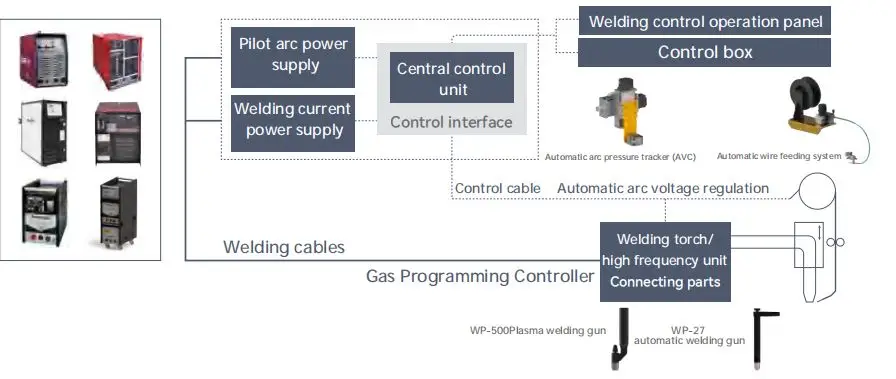
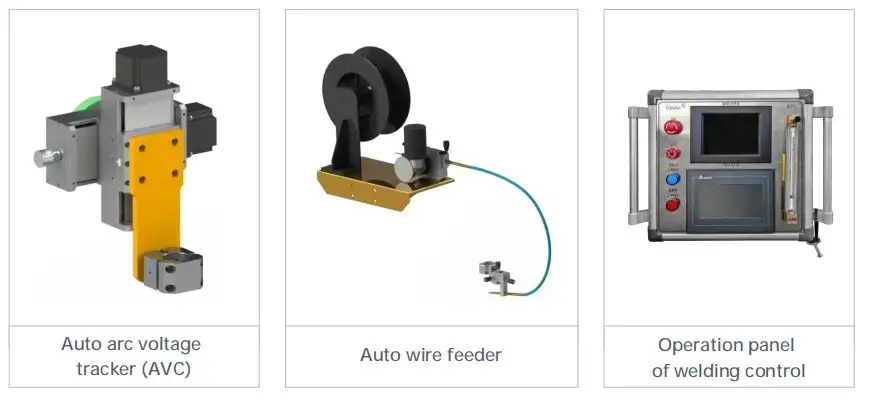
Plasma automatic welding system composition:
1. System components:
System components
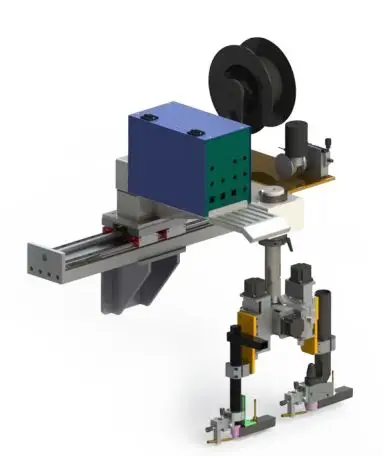
2. Automatic welding torch

Plasma+TIG Double welding torch technology

plasma welding power + TIG welding power
Plasma generator
Plasma welding torch (optional wire filling)
TIG torch with shield gas dragging cover

Automatic welding torch


3. Other accessor
Other accessor

Competitive Advantage

What are the characteristics of plasma welding?
High arc compression: The plasma arc, passing through the tiny channels of a water-cooled copper nozzle, undergoes mechanical, thermal, and electromagnetic compression to form a columnar arc with extremely high energy density.
Strong penetration ability (keyhole effect): Under appropriate parameters, the plasma arc can penetrate the workpiece to form a "keyhole," achieving single-sided welding with double-sided forming, and a neat back side.
Good arc stiffness: The arc is straight, highly directional, and not easily deflected, making it insensitive to assembly gaps.
Higher welding speed: Much faster than TIG welding, especially for medium-thick plates requiring single-pass penetration.
Weldable thickness range: From foil (0.1mm) to thick plates (over 12mm, single-pass penetration; multi-layer welding can achieve even thicker thicknesses).


What are the advantages of plasma welding?
Strong penetration:It has strong penetration, bellow 12mm plate welding need not make edge beveling, reducing the preparation time greatly and the amount of wire filling before Welding.
Concentrated highly plasma arc energy:The plasma arc energy is concentrated highly, the thermal effected area is smaller during welding and less deformation after plate welding.
Fast welding speed:Plasma welding is faster than Manual TIG welding and raised by 4-5 times working efficiency.
Single-sided welding & two-sided forming:The rigidity of arc column is strong and using small hole effect can achieve stable performance of single-side welding and two-sided forming, the height, width and narrowness of internal and external welding seams are uniform and beautiful look, which reduces the workload of post-welding seams treatment.
Good welding quality:Good welding quality and suitable for a lot of welding materials.
Long usage life:The electrode is designed in the nozzle of plasma torch, not easy to be burned down and contaminated, long life for electrode usage.
Good controllability:The plasma arc has good controllability and adjustability on welding.
Automatic welding:Plasma welding is automatic mode and easy to be operated, suitable for repeated mass production.


What are the disadvantages of plasma welding?
High equipment cost: It requires a dedicated plasma power supply, welding torch (including tungsten electrode and compressed nozzle), and cooling system (water cooling), making it 2-5 times more expensive than TIG welding machines.
Short nozzle consumable life: The orifice of the compressed nozzle is easily contaminated by the tungsten electrode or burned by the arc, requiring frequent replacement.
Complex operation and adjustment: The parameter window is narrow (current, plasma gas flow rate, welding speed, nozzle height, etc.). Improper settings can easily lead to uncontrolled orifice welding, undercut on the back side, or incomplete penetration.
Unsuitable for thin plate pinhole welding: For plates thinner than 1mm, the pinhole effect is difficult to stabilize, and penetration-type plasma welding (similar to TIG) is usually used instead.
High requirements for gas source:Rare metals require high-purity argon, while others require a hydrogen-argon mixture, and the plasma gas and shielding gas need to be adjusted independently.

Recommendations for PAW Welding
Thickness Range: Optimal thickness for through-hole (pinhole) welding: Stainless steel, titanium alloys 3~12mm (single-sided welding, double-sided forming, no beveling).
Example: 4mm stainless steel, one-time penetration, uniform back side.
Thick plate applications: >10mm, beveling possible, multi-layer welding.


Recommended materials:
Optimal materials: Stainless steel (304, 316, duplex steel), titanium and titanium alloys, nickel-based alloys (Hastelloy, Inconel), copper alloys (especially thick plates), carbon steel, aluminum.


Joint types:
Fillet welds: Rarely used due to the straight plasma arc, making fillet weld control difficult; usually replaced by MIG or manual welding.
Circular/Longitudinal welds: Suitable for both, especially with automatic plasma welding and rotating fixtures, for circumferential welds in pipes and cylinders.
Typical application example: Longitudinal weld in pressure vessel cylinders: 8mm stainless steel, no beveling, through-hole plasma welding, one-time forming, back side reinforcement ≤1mm.

Application

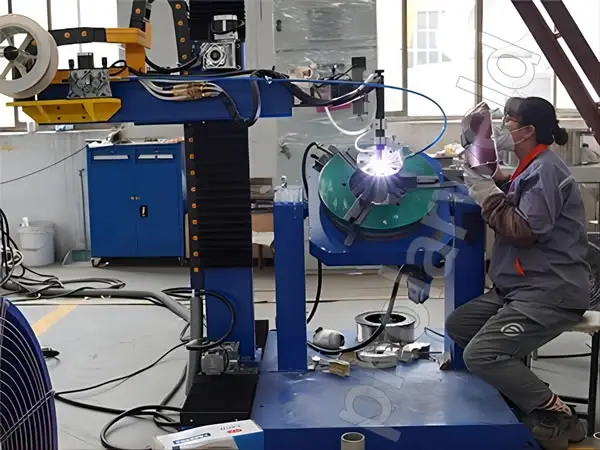
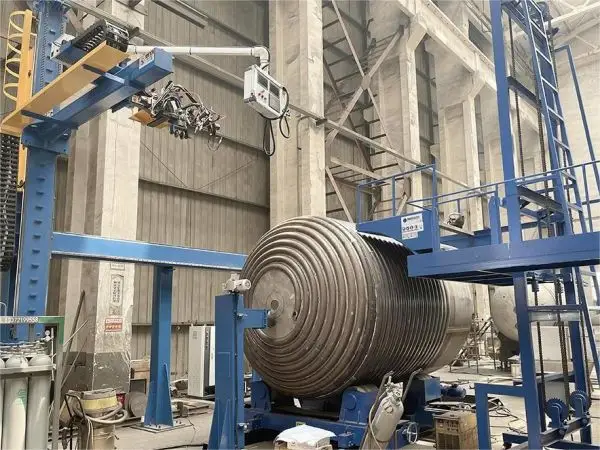
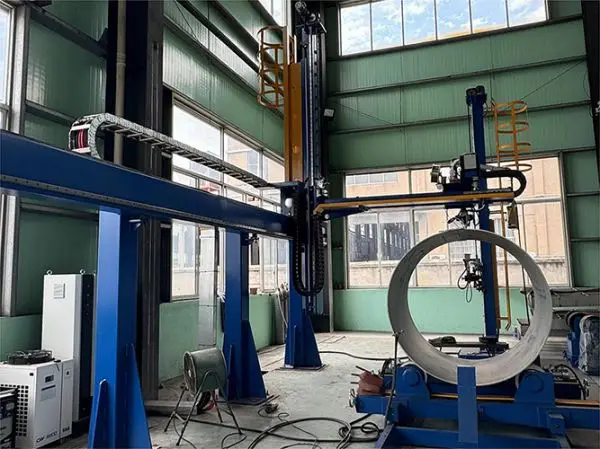
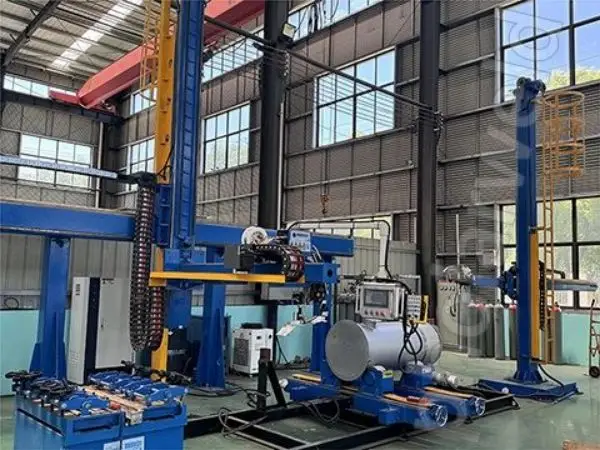
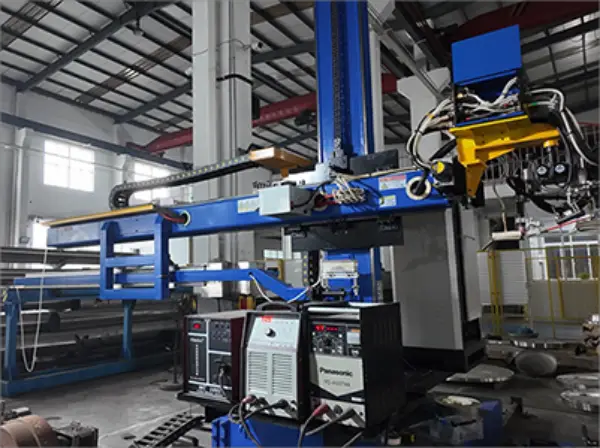
Gantry Side-beam Auto Welding Equipment
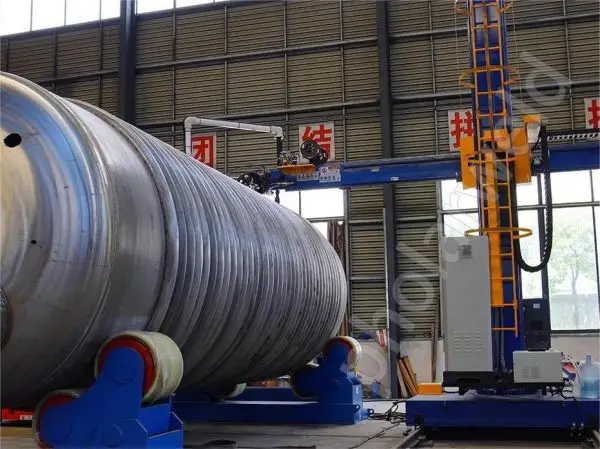
Cylinder Coil Pipe Auto Welding Equipment
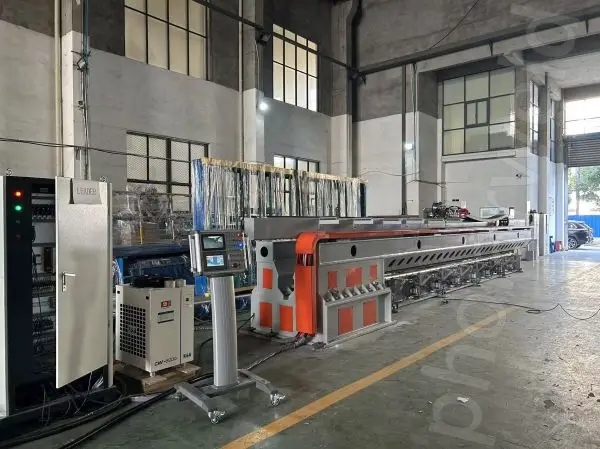
Auto Plate Butt Welding Machine Configuration
Gantry Side-beam Auto Welding Equipment

Faqs

  • What types of automated equipment does your company primarily sales?

    Our company specializes in the research, development, manufacturing, installation, and sales of various automated plasma welding equipment, deep penetration welding equipment, robotic welding stations, wear-resistant surfacing equipment, welding auxiliary equipment, robotic cutting workstations, grinding and polishing machines, automatic coiling pipe machines, and non-standard automated production lines. We also handle and act as an agent for various import and export businesses.

  • What after-sales services are provided for this equipment?

    Our company provides comprehensive after-sales services, covering equipment commissioning, parameter optimization, operator training, and long-term maintenance. In case of emergency malfunctions, we promise to provide remote guidance within 24 hours. We also conduct regular follow-up visits, spare parts supply, and technical consultation services to ensure your production runs smoothly.

  • Can I visit your company to observe equipment operation or perform trial welding?

    Yes. We welcome customers to visit our factory and observe equipment demonstrations. If needed, we can arrange trial welding using actual workpieces provided by you to verify the equipment's process effectiveness and weld quality.

  • How much more efficient is automated welding equipment compared to manual welding?

    Automated welding equipment can operate continuously for 24 hours. For the same weld specifications, the time required is reduced by 2-3 hours compared to manual welding, increasing efficiency by over 60%. For example, a job that would take 3 skilled welders 3 days to complete can be finished with high quality in 1 day by a single welding robot, while also reducing wire and gas consumption by 20%-40%. Overall, automated welding can reduce labor costs by approximately 60%.

Talk to Our Expert

Send us your quote request and we will generate a quote for you with all the information you need.

Talk To Our Expert