PholarWeld Automation Equipment Co., Ltd.

Metal Active Gas (MAG)

Home > Welding Technology > Metal Active Gas (MAG)

Home > Welding Technology > Metal Active Gas (MAG)

Metal Active Gas MAG11
MAG
Metal Active Gas MAG11
MAG

MAG Welding technology GMAW process Metal Active Gas Welding


Metal Active Gas (MAG)

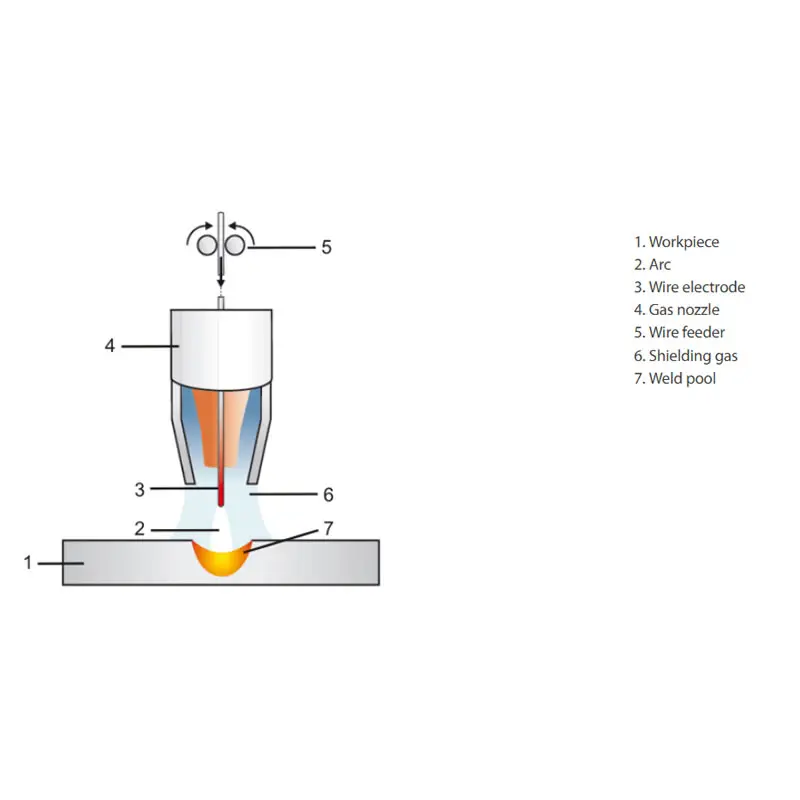
MAG welding, the full name of Metal Active Gas Arc Welding, is an arc welding method that uses a continuously fed welding wire as a melting electrode, and a mixed gas with a small amount of oxidizing gas (such as CO₂ or O₂) added to argon (Ar) as a protective medium.

At present, the most commonly used gas mixture is "80% Ar + 20% CO₂". This gas is called argon-rich mixed gas, so MAG welding is also often called argon-rich mixed gas shielded welding.

Inquiry Now PDF Download

Introduction

Flexible Leasing & Sales

Breaking away from the single sales model, we offer diversified solutions combining "equipment sales + flexible leasing".

Non-standard customization

We provide professional non-standard equipment customization services to address customers' specific workpiece materials and complex process pain points.

Special Builds

If you have unique requirements, we offer special design options tailored to your specific requests.

Specification

MAG welding vs Manual welding
TechnologyMAG weldingManual welding (rod arc welding)
Operation modeSemi-automatic/automatic, continuous wire feedingAll manual, intermittent welding
Welding efficiencyHigh, fast speed, high deposition rateLow, need to frequently replace welding rods and clean slag
Welding qualityGood, no slag, beautiful shapeNormal, with slag, quality depends on skill
Welding positionAll locationsAll locations
Penetration abilityLarge, thicker can be welded without bevelingSmaller, thicker plates require larger bevels
Skill requirementsLow and easy to graspHigh, depends on the welder's skills and experience
Wind resistancePoor, not suitable for outdoor useGood, the medicinal skin has strong protection against wind
Equipment costhigherlow
comprehensive costLower (high efficiency, less consumables)Higher (low efficiency, more consumables)

Competitive Advantage

What are the characteristics of MAG welding?
The protective gas is "active": this is its core characteristic. By adding active gases such as CO₂ or O₂, the weld can be formed better and the penetration deeper.
Various droplet transfer forms: short circuit transfer, spray transfer, pulse spray transfer, etc. can be used to adapt to different material thicknesses and welding positions.
Both stability and efficiency: It not only has the characteristics of stable arc of argon arc welding, but also has larger penetration depth and faster welding speed.
Relatively tolerant requirements for workpiece surface: slightly higher tolerance for oil stains and rust than MIG welding, and stronger adaptability.
Lower welding costs: The cost of active gas is lower than that of inert gas, which reduces costs while ensuring quality.


What are the advantages of MAG welding?
High welding efficiency: continuous wire feeding, fast welding speed and high deposition rate, suitable for mass production.
Good weld formation and deep penetration: The active gas improves droplet transfer, giving the weld a smooth appearance while enabling deeper penetration.
Good arc stability: The active gas can effectively stabilize the cathode spots and make the arc combustion more stable.
Strong welding ability in all positions: By adjusting the transition form and process parameters, it can be used in various positions such as flat welding, vertical welding, and horizontal welding.
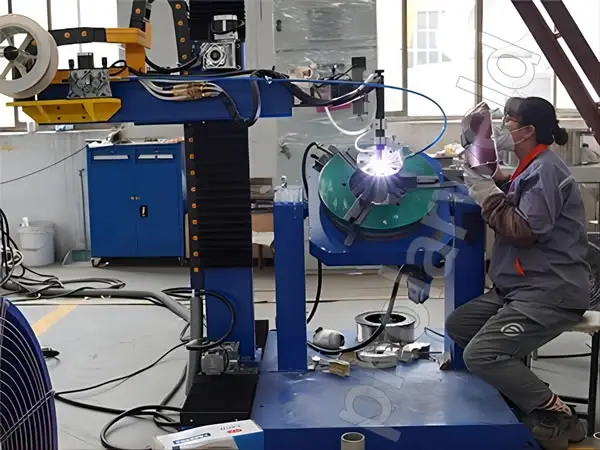
Easy to automate: The stable process makes it ideal for robotic welding and automated production lines.
High cost-effectiveness: Compared with MIG welding, the cost of mixed gas is lower; compared with electrode arc welding, there is no need to frequently replace the electrode, and the overall efficiency is significantly improved.


What are the disadvantages of MAG welding?
Relatively large spatter: Although it is better than pure CO₂ welding, its spatter is still larger than TIG welding and needs to be cleaned.
Poor wind resistance: the protective gas is easily blown away by the wind and is not suitable for outdoor operations.
Specific defects may occur: In some cases (such as high-strength steel welding), hydrogen-induced pores, slag inclusions, lack of fusion, etc. are prone to occur, and the process needs to be precisely controlled.
The equipment cost is higher: it needs to be equipped with a welding machine, wire feeding mechanism, gas cylinder, etc., and the initial investment is higher than that of manual welding.
Not suitable for active metals: When welding aluminum, magnesium and other metals, active gases will cause oxidation, so MIG welding must be used.

Selection suggestions (under what circumstances should you choose MAG?)

Thickness range:

Thin plate (≤3mm): mainly short circuit transition, suitable for welding of thin plate, galvanized plate, etc.
Medium-thick plate (3-12mm): the most commonly used range, especially 6-12mm, which can be used without bevel or small bevel to achieve high penetration and efficient welding.
Thick plate (>12mm): multi-layer multi-pass welding or narrow gap MAG welding (N-GMAW) technology, suitable for 40mm-400mm or even thicker structural parts.


Material recommendation:
Carbon steel/low alloy steel/high-strength steel: MAG welding is the core application, which can balance welding quality and cost.
Stainless steel: It can effectively improve the viscosity and undercut problems of liquid metal during pure argon protection, and is one of the preferred processes.
Galvanized sheet: Special process can effectively solve the problems of spatter and pores caused by zinc vapor.


Connector form:
Butt joint: An ideal joint that takes full advantage of the large penetration and allows 10mm thick plates to be completed with fewer weld passes.
Fillet/Tee joints: ideally suited, "boat welding" allows for efficient welding.
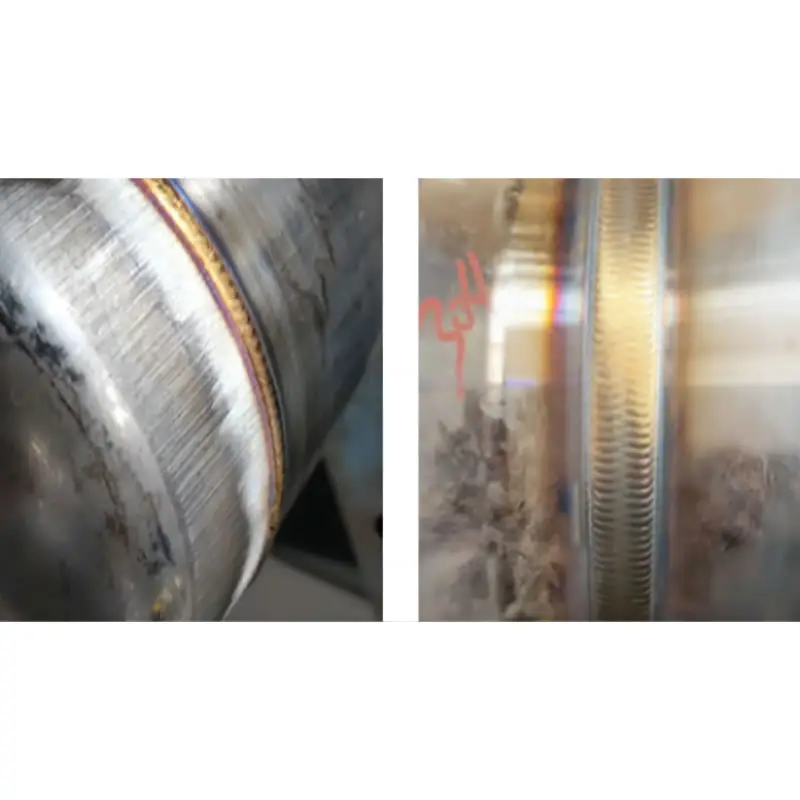
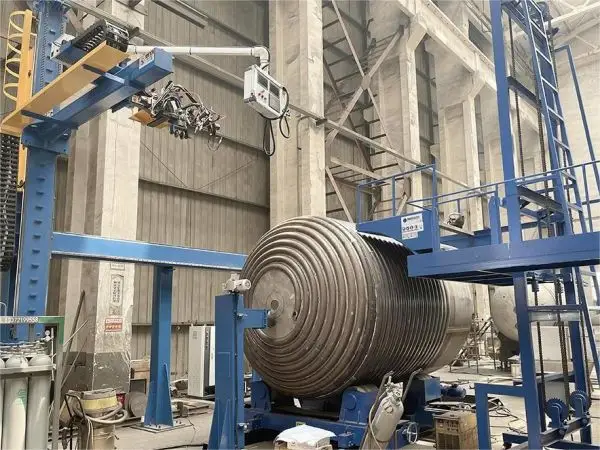
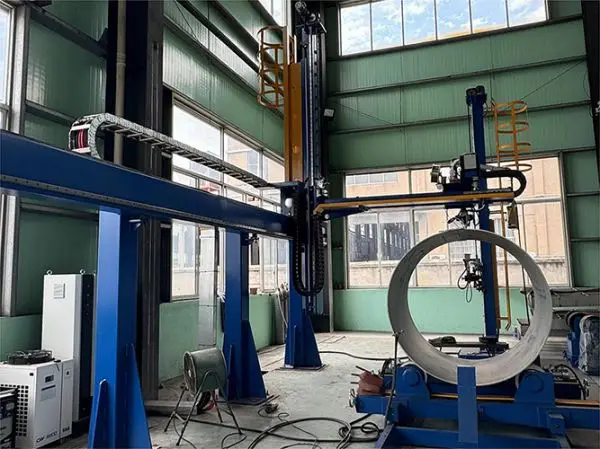
Circumferential seam: widely used in welding of rotating bodies such as pipes and pressure vessels, especially narrow gap MAG welding technology.


Typical application cases:
Steel structures and bridges: Effectively reduce groove processing, number of welding passes and welding deformation, improving efficiency and quality.
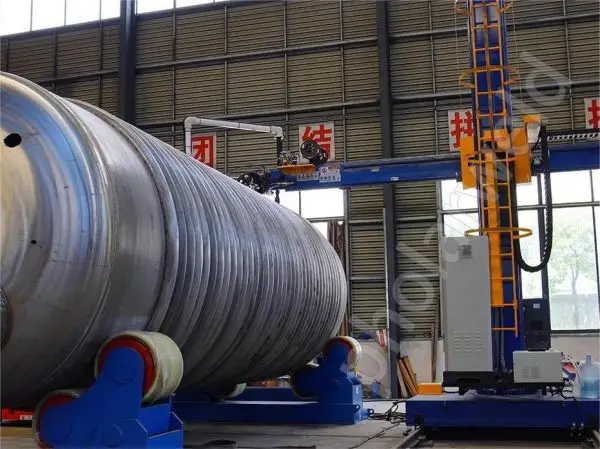
Pressure vessels and pipelines: With narrow gap technology, the welding efficiency and quality of thick-walled vessels, boiler drums and other products can be greatly improved.
Heavy machinery and ships: It is the core process of manufacturing large structural parts such as cranes, excavators, and ship hull segments, especially in automated welding lines.
Automobile manufacturing: widely used in the welding of chassis, frames, seats and other parts.
Automated production line: Because of its stable, efficient and easy-to-control process, it is the preferred process for robot welding production lines.

Application

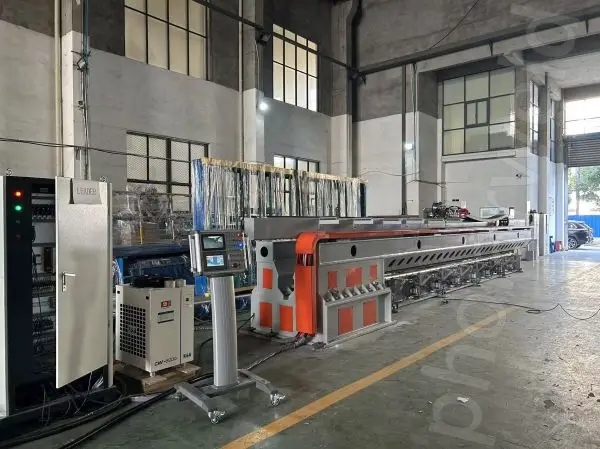
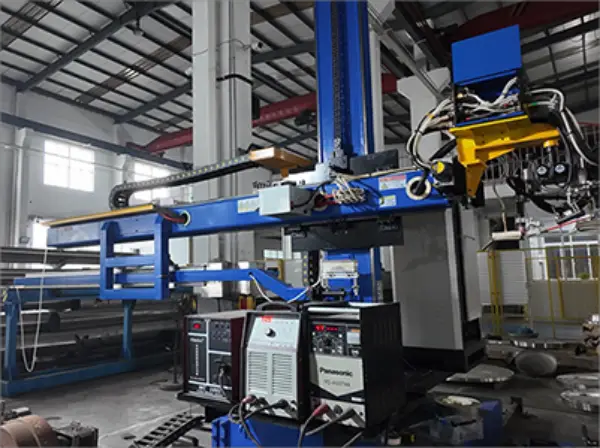
Gantry Side-beam Auto Welding Equipment
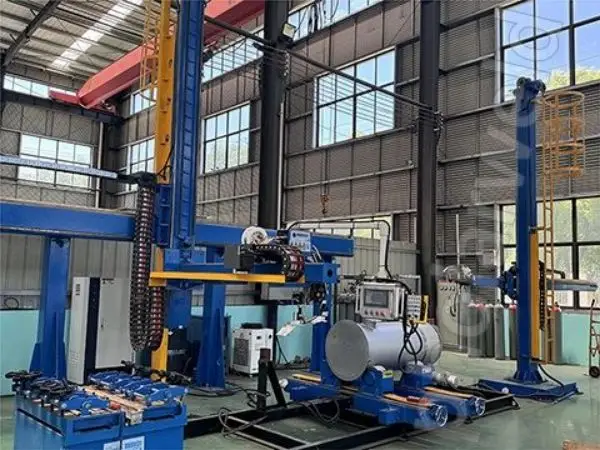
Cylinder Coil Pipe Auto Welding Equipment
Auto Plate Butt Welding Machine Configuration
Gantry Side-beam Auto Welding Equipment

Faqs

  • What types of automated equipment does your company primarily sales?

    Our company specializes in the research, development, manufacturing, installation, and sales of various automated plasma welding equipment, deep penetration welding equipment, robotic welding stations, wear-resistant surfacing equipment, welding auxiliary equipment, robotic cutting workstations, grinding and polishing machines, automatic coiling pipe machines, and non-standard automated production lines. We also handle and act as an agent for various import and export businesses.

  • What after-sales services are provided for this equipment?

    Our company provides comprehensive after-sales services, covering equipment commissioning, parameter optimization, operator training, and long-term maintenance. In case of emergency malfunctions, we promise to provide remote guidance within 24 hours. We also conduct regular follow-up visits, spare parts supply, and technical consultation services to ensure your production runs smoothly.

  • Can I visit your company to observe equipment operation or perform trial welding?

    Yes. We welcome customers to visit our factory and observe equipment demonstrations. If needed, we can arrange trial welding using actual workpieces provided by you to verify the equipment's process effectiveness and weld quality.

  • How much more efficient is automated welding equipment compared to manual welding?

    Automated welding equipment can operate continuously for 24 hours. For the same weld specifications, the time required is reduced by 2-3 hours compared to manual welding, increasing efficiency by over 60%. For example, a job that would take 3 skilled welders 3 days to complete can be finished with high quality in 1 day by a single welding robot, while also reducing wire and gas consumption by 20%-40%. Overall, automated welding can reduce labor costs by approximately 60%.

Talk to Our Expert

Send us your quote request and we will generate a quote for you with all the information you need.

Talk To Our Expert